State News
Michigan poll workers' marks don't void your ballot; spoiled ballots are replaced, not tossed
The rumor in Sterling Heights is false: poll workers’ marks go in the poll book, not on your ballot, and numbered stubs are removed before counting.
By Staff · October 17, 2026
A persistent national rumor — spread through community conversations, group chats and social feeds — falsely claims that if a poll worker marks your ballot, your vote gets thrown out.
It is false. The marks a Michigan election worker actually records — the ballot number, the voter’s identifying number, and the worker’s initials — are routine record-keeping. They are written on the Application to Vote, the poll book, and in the electronic poll book, not over the voter’s choices on the ballot itself.
The ballot’s unique number is pre-printed on a detachable stub. When the voter returns the marked ballot, the inspector matches the stub number to the number recorded on the Application to Vote and removes the stub before the voter feeds the ballot into the tabulator. Because the stub comes off before counting, the number is not on the counted ballot and cannot be connected to how that voter voted.
No mark an election worker records changes the voter’s choices, and a worker’s record-keeping mark does not alter who the ballot counts for.
A mark on a ballot generally counts as a vote only if it is placed inside the designated voting target area and is consistent with the voter’s other marks. A stray or administrative mark outside the target area is not treated as a vote and does not invalidate the ballot. Ben Hovland, former chair of the U.S. Election Assistance Commission, put it plainly: the tabulator is “looking for the oval to be filled out in the specific slots... A stray mark is unlikely to do that and there are other safeguards to ensure the voter’s intent is reflected.”
What changed — and what didn’t
Nothing changed for this fall’s election. Michigan’s in-person ballot-handling procedures — recording the ballot number and voter number, initialing the poll book, and spoiled-ballot replacement — remain what they were in 2024.
Michigan’s recent voting changes, including at least nine consecutive days of early in-person voting and other post-2022 Proposition 2 reforms, govern when and how people can vote — they do not change what an election worker may or may not write on a ballot. Michigan requires paper ballots in every election, and those paper ballots are counted by machine.
When a ballot is truly spoiled
A ballot becomes spoiled only when the voter realizes their own mistake and asks to start over, or when the tabulator flags a problem — such as marking too many candidates in one race — and the voter chooses to spoil the ballot. A poll worker does not review a voter’s marked choices to catch mistakes.
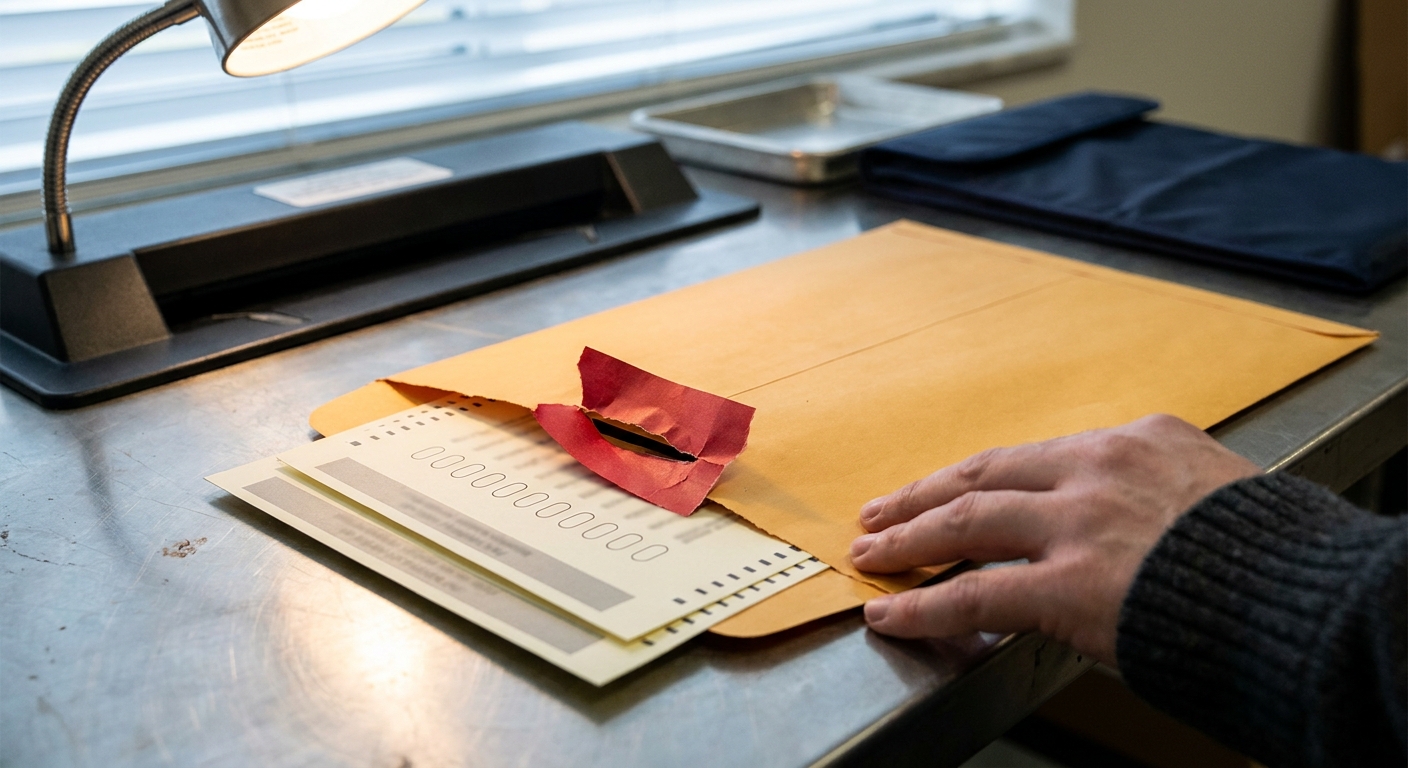
When a voter genuinely spoils a ballot, a worker writes “Spoiled” across its face and seals it in a “Spoiled Ballots” envelope. The spoiled ballot is set aside in the envelope, which is secured with a red paper seal after polls close to be stored in the ballot container, where it cannot be counted. The voter is then issued a fresh, blank replacement ballot to mark.
A spoiled ballot is voided and set aside so it can never enter the count — it is replaced, never silently tossed.
The person making those marks is a trained election worker from your own community — a neighbor working the polls — following rules set by the Michigan Secretary of State in the Election Officials Manual.
If you ever notice a mark and are unsure what it means, speak up and ask the election worker right at your polling place. The vote is protected, not at risk — and a ballot that is genuinely spoiled is replaced on the spot.